Posts

Striving for Higher-Order Thinking and Depth of Knowledge
Image
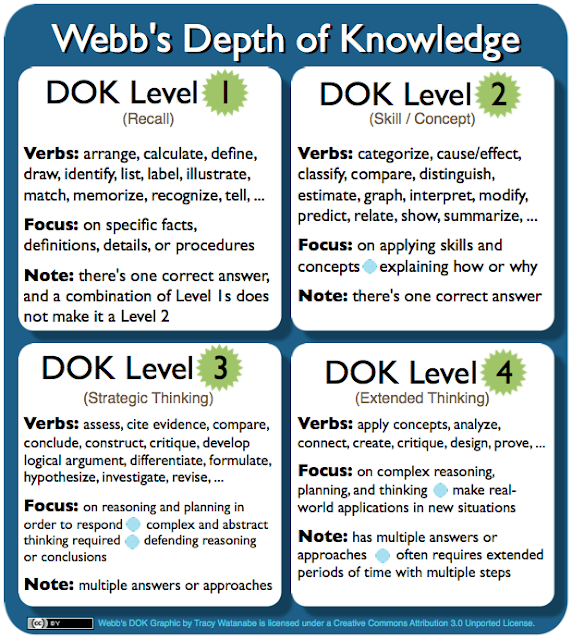
A little over a year ago, I read Higher-order thinking is the exception rather than the norm for most classrooms on Scott McLeod's blog, Dangerously Irrelevant , and have been mulling it over, wondering if our school district is any different. Over the past year, our teachers periodically collect data with their teams on the types of questions/tasks they ask students. One teacher records teacher questions and the other records student responses on a shared Google Doc ; then teams sort through their own data, plotting teacher questions by Bloom's Revised Taxonomy , and student responses to those questions/tasks with Webb's Depth of Knowledge (DOK) . The 2012-2013 data showed we were not very different from other districts; therefore, our teams set their own goals for higher-order thinking and depth of knowledge. The data so far for the 2013-2014 school year shows questions asked of students are up and down the Bloom's ladder, equally distributed (with a little...

Nominations for the 2013 Edublog Awards

Image
The purpose of the Edublog Awards , or Eddies, is to raise awareness of educational blogging and social media for learning. Image Credit: Edublogs Here are my nominations: Best individual blog -- Mrs. Yollis' Classroom Blog ( Linda Yollis ) Best group blog -- Cougar News Blog (authored completely by 7th & 8th grade students, with the guidance from Journalism Teacher Jason Davis ) Best new blog -- Salsich Team 5 ( Jonah Salsich 's Class Blog) Best class blog -- Mrs. Hamman's Class Blog (posts are mainly written by the students) Best student blog -- Em's Canvas (2nd grade student) Best ed tech / resource sharing blog -- Langwitches ( Silvia Rosenthal Tolisano ) Best teacher blog -- EdTech Workshop ( Andrea Hernandez ) Best library / librarian blog -- Bulldog Reader's Blog ( Julie Hembree ) Best administrator blog -- This and That ( Jon Castelhano ) Most influential blog post of the year -- My TEDxDesMoines video: From Fear to Emp...

Self Selected Professional Development

Image
Original Photo Credit: 96dpi via Compfight cc     Adapted by: Tracy Watanabe cc Twitter Chats are fabulous self-selected professional development. A Twitter Chat Group is a group of people who come to Twitter to "discuss" a specific topic of interest. During the Twitter Chat, moderators will ask questions around the topic, and participants will answer. It requires some fast thinking to respond and read other responses. Every Twitter Chat I've been part of has given me new ideas/resources, affirmed other ideas, and/or motivated me to follow through with the next step. For example, the recent discussion on Connected Principals Twitter Chat , #cpchat, discussed how principals (and administrators in my case) can use Twitter to help connect educators. How can districts give Professional Development credit for Twitter Chats? I've grappled with this idea for a few years and believe I've come up with a solution that would work in my school district. ...

Collaboration and Management in Google Apps

Image
Original Photo Credit: star5112 via Compfight cc Adapted by Tracy Watanabe Two heads are better than one.   October is Connected Educator's Month . Get connected, and move beyond connection to collaboration. Collaboration is key for this day and age in both face-to-face and virtual environments. One of my favorite collaborative tools include Google Apps for Education. The presentation below was created for a training I offered regarding collaborating in Google Apps and tips for management with those tools . What are ways you use Google Apps to collaborate with others? What management tips would you add to this? What thoughts or questions do you have about collaboration and management in Google Apps?

Grading to Support Learning

Image
Grading should support the learner by being meaningful, accurate, consistent, and encouraging. Grades should encourage student success and the learning process by providing a valid measurement of student performance and achievement. The frustration is, there is nothing consistent with grades. We all grade differently. It's subjective no matter how we look at it because how one teacher would grade something is different than the teacher next door, which is different than the teacher across the district, which is different than the teacher in another district.  What would happen if teachers forgot how they were graded when they were in school, and instead used a grading system that fostered student learning? What would that look like?  #1 Academic achievement is separate from learning dispositions and behaviors Academic grades should measure the student's learning, and be a valid reflection of what the student has mastered according to the state (or district) standards...

Building a Learning Culture

Image
Professional development manifests itself in many ways online and in person. It takes place through conversations, classes, Twitter chats , workshops, blogging, book studies, challenges, team meetings, etc. Leadership Day 2013 Image by Scott McLeod Model what you want to see Sometimes the best professional development comes informally through the behaviors of others, influencing how I think and what I think about. I learn so much from my children. We have fabulous conversations about life, they share new perspectives and creative solutions with me. They also teach me how to be a better person through their inquiries and their behaviors. I do my best to be a good model for them, but some of their behaviors are ones I'd like to see change, but no matter how much we talk about it, they continue with the same behaviors. That's when it dawns on me, they are behaving the way we the parents are behaving. So, if I want their behaviors to change, it means my behaviors have t...

How are We Using Technology in Classrooms?

Image
Technology has changed how we do things in our daily lives such as shopping, banking, communicating, and it has changed how we should do school. Photo Credit: Reeding Lessons via Compfight cc When I was a child, I remember spending so much time going through microfiche to find just the right bit of information to share with the teacher. In those days, finding the right information and recollecting that information was the mark of a good student. Today, knowledge and information is at our fingertips. In fact, there is so much information that it's tough to know where to start and what's the best source to use. Therefore, accessing the right information at the right time is more important than just finding information. Focusing on skills rather than knowledge is a shift in how we do school. It changes what students are taught and how they are taught. What do these shifts look like in the classroom? This type of learning is easy to capture because there are ...