Posts

Showing posts with the label collaboration

Global Collaboration
Image
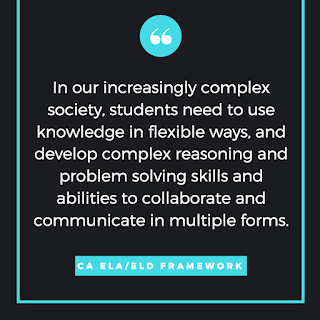
In order to prepare students to apply rigorous learning to new and real-world situations, educators must provide opportunities that foster critical and creative thinking, communication and collaboration. Importance of Global Collaborations Common Core State Standards demand students to collaborate with diverse partners , thereby expanding students' global awareness . Some of the benefits of collaboration might include: Developing interpersonal skills of working together as a team. Fostering critical thinking skills while working towards a collaborative goal. Increasing comprehension while partaking in conversations and exploring ideas from different perspectives. "Collaborative learning promotes communication among students; it is particularly beneficial for English Learners (ELs) because peer interaction contributes to the development of language," ( CA ELA ELD Framework, Chapter 2 ). New 2016 ISTE Standards for Students I recently attended th...


Comments for Community to Enter a State of "Flow" #C4C15

Image
According to Mihaly Csikszentmihalyi, happiness and genuine satisfaction comes from a state of consciousness called flow . To achieve flow, one must be completely absorbed in an activity, a mindful challenge, involving creativity. Those mindful challenges can not be too demanding, nor too easy. This "mindful challenge" reminds me of a volleyball net. If it is set too high, it is too difficult to hit the ball over the net, resulting in giving up the game out. Likewise, if the net is too low, there's not enough challenge to keep my attention, leading to the same outcome of giving up the game. Thus, we need to set the net at the appropriate height, and then we'll start learning how to make changes to improve, which is when we'll become intrinsically motivated by the act. “Most enjoyable activities are not natural; they demand an effort that initially one is reluctant to make. But once the interaction starts to provide feedback to the person's skills, i...

Mystery State Skype

Image
Mystery State Skype isn't a new idea, it's basically taking learning geography and placing it in a game format like Twenty Questions via Skype, by asking questions to guess the location of the other classroom. Not only does this connect students from across the country (or globe), but it also gives a context for students to apply geography with critical reasoning, collaboration, communication, digital citizenship, and information fluency -- 21st century skills . Skype in the classroom Learning standards What should your students research? I recommend looking at your standards to know what is expected of your students as a starting place. Geography standards --  History-Social Science Content Standards   Consider the research writing standards (see CCSS ELA Writing Standards #7 - 9 ) Converse and collaborate with diverse partners -- CCSS ELA Speaking and Listening #1 21st Century Skills -- ISTE Standards for Students Note that your students will read information...

My #HackEd2014 Summary and Reflections

One of my favorite conferences is ISTE Unplugged / Hack Education . The schedule of the discussions is decided the day of the conference based on the interests of the participants. What is appealing to me about Hack Education is the small group setting that fosters deep discussions, and the organic nature of the conversations that are completely based on the group's expertise and ability to ask probing questions. I always feel like I walk away smarter. My notes for some of the sessions are illustrated below as sketchnotes with thinglinks/interactive links, bullet points, or as the main points I Tweeted out. Personalized Learning - facilitated by Barbara Bray Click here to view above image with thinglink 1:1 Deployment Click here to view above image with thinglink Smackdown Official HackEd Smackdown sharing. Tracy's HackEd Smackdown notes. Community, Global Connections using tech to build relationships Click here to view abov...

Writing 2.0: Technology-Rich Approach to Common Core Writing

Image
What skills are most desired by employers? On most lists , communicate effectively is the number one desired skill. How do we communicate? We communicate face-to-face, in writing, through various technologies, and multimedia. What is does it mean to be literate? Being literate is being able to effectively communicate. Therefore, every classroom must teach digital literacy as part of literacy, and not something separate. Original image by Andrea Hernandez Why have technology-rich writing? Writing is a huge piece of literacy. Writing should occur across content and grade levels. Common Core writing requires students to create and publish writing online, and to interact and collaborate with others. Writing Anchor Standard #6 : Use technology, including the Internet, to produce and publish writing and to interact and collaborate with others. We must design lessons that incorporates digital mediums for students to communicate and collaborate with others. "(St...

Collaboration and Management in Google Apps

Image
Original Photo Credit: star5112 via Compfight cc Adapted by Tracy Watanabe Two heads are better than one.   October is Connected Educator's Month . Get connected, and move beyond connection to collaboration. Collaboration is key for this day and age in both face-to-face and virtual environments. One of my favorite collaborative tools include Google Apps for Education. The presentation below was created for a training I offered regarding collaborating in Google Apps and tips for management with those tools . What are ways you use Google Apps to collaborate with others? What management tips would you add to this? What thoughts or questions do you have about collaboration and management in Google Apps?

Close Read Complex Text, and Annotate with Tech--Part 1

Image
Students need to be taught how to read complex texts. One of the strategies for learning how is close reading . It slows the reader down to notice and ponder more. It also connects meaning and builds systems of thought . Text complexity with close reading Complex text requires a close reading. So what makes a text complex ? There are three "ingredients" to text complexity: It's important to understand text complexity to build students' literacy skills. As they become more skilled, they will read more complex text on their own. Introduction to close reading Here's an overview of close reading: What does close reading look like in the classroom? Here are some examples of close reading at different grade levels and content areas (or components of it such as annotation): 9th-10th grade -- Thinking Notes: A Strategy to Encourage Close Reading by the Teaching Channel 10th grade, Close Reading with nonfiction 6th grade, Teaching Annotation ...

Collaboration Coaching Chronicles

Image
Today is our last Collaboration Coach Meeting of the school year, and we're celebrating all they've accomplished at their sites. Collaboration Coaching is modeled after the research-based Microsoft Peer Coaching Program , developed by the Peer-Ed Team . The training focuses on coaching and collaboration skills; best practices in lesson design and instruction; and, technology integration and engaging practices. Collaboration Coaching fosters an environment where it is safe to take risks to try innovative practices, to engage students in critical thinking, collaboration, communication, and creativity. This shift is occurring more rapidly because teachers have ongoing professional development by having someone they trust, a Collaboration Coach, who is just down the hall or right next door. Coaching Chronicles There are six fantastic "Coaching Chronicles" inside this Prezi created by the coaches at each of the schools sharing their "story" of 21st cent...

Collaboration Coaching

Image
As we wrap up our second year of Collaboration Coaching , we celebrate the success we've had with collaboration, learning with colleagues, and creating 21st century, student-centered classrooms. What is a Collaboration Coach? Our Collaboration Coaching is based on the Microsoft Peer Coach Training developed the Peer-Ed Team. We've adapted it to fit our district's needs. The Collaboration Coach training presents an opportunity for Apache Junction Unified School District teachers to explore coaching as an effective model for providing ongoing professional learning with classroom teachers focused on 21st century learning, Common Core, technology integration, and best teaching practices. Coaches receive training and support that includes methods of coaching, fostering collaboration, and action planning for successful coaching. Project emphasis infuses technology to create and promote: differentiated instruction through a variety of strategies based on student ne...

Common Core and Service Learning PBL Professional Development

Image
Yesterday I had the privilege of facilitating a Common Core and Project Based Learning professional development class for 7th-12th grade teachers. Prior to my training, they had two days of ELA Common Core and one day of deconstructing performance assessments for ELA Common Core. Meeting their needs through professional development While I had a rather large group (over 40 and had to turn people away to go to another class since all of the computers and chairs were taken), over half of them had taken a PBL class with me before and were implementing it in their classrooms, yet only one had ever tried service learning . I knew that what I had prepared for them would not meet their needs since I had created it as an introduction to PBL. Service learning was the direction I took them in because it addressed their needs the best, we'd get great cross-curricular discussions, and time to reflect and process the past three days of Common Core training . Build background knowl...

STEM, PBL, Common Core, and 21st Century Learning

Image
Just a few weeks ago, I was asked by our Governing Board if some students and teachers could share about Project Based Learning at the next Board Meeting, and it was easy to say yes because PBL has found a home at AJUSD.   Solar exploration in Mrs. Hamman's 5th grade class This STEM project was student driven. They researched problems and solutions on their own, and concluded that solar energy could help solve problems with purifying drinking water and eliminating the health hazards and environmental damage of cooking fires. Here's an overview of their project, created by the students: Listen to this insightful student reflection (also inside the Popplet above): I loved how their reflection captured the authenticity of the learning driven by their interests, the rigor of the project, the relevance to them and others, their responsibility and commitment to their learning, and the insight gained from this PBL. Water quality in Mrs. Go...

Vision, Urgency, and Measuring Effectiveness

Image
I've been involved in several discussions about leading change , which started with  vision and urgency. Everyone needed to be on the same page about the vision (the what), have a sense of urgency (the why), and know how we'd measure progress towards our goal. Having the vision relevant, tangible with benchmarks, and feedback reminded me of successful classroom practices. In the classroom, I made sure my students knew what we were learning, how it was relevant to them, how we'd measure progress towards our goal (the what, why, and how), and involved them in the process. I realized leading change had some of the same foundations, such as starting with the vision. Vision In order to be purposeful about change, the vision for what is wanted must be clear by everyone. If I asked, "What does it mean to be a 21st century, student-centered school district?" the answer must be clear in the minds of everyone. It must be clear to the administration , the teachers, ...