Posts

Showing posts with the label Assessment

Formative Assessment with Plickers

Image
Formative assessment helps teachers make data-informed decisions to plan for and/or adjust instructional activities, identify potential misconceptions, monitor the pace of instruction, etc. While there are many ways to formatively assess students, I recently saw  Eric Sheninger use Plickers during his workshop at the Ventura County Office of Education, and thought, what an easy and inexpensive way to quickly assess groups! . @E_Sheninger Using Plickers #l3vcoe pic.twitter.com/rEHcTMgNKb — Tracy Watanabe (@tracywatanabe) November 7, 2014 Purpose and benefits Collect data from multiple choice or true/false questions from a group. View data as a group snapshot in a graph, or view individual data from audience. Quick, low-tech tool to use, especially when you don't have the budget for clickers. Technology and prep Teacher/Facilitator creates an account at Plickers . Download app for portable device: iTunes or Google Play . Print out a set of reusable  car...

Formative Assessment and Google Forms

Image
Formative assessment informs educators about student learning, and when done correctly , it also informs the students how to improve and move forward with their next goal. Teachers must know how to use the data to drive their instruction. Formative Data by Tracy Watanabe - Created with Haiku Deck, presentation software that inspires Gleaning results from the data and providing specific feedback must be timely, which is why I like using Google Forms (along with other tools). Why Google Forms While there's a plethora of tools that can be used to collect formative data, I am going to focus on Google Forms. Google Forms is an awesome time saver for collecting data in surveys, assignments, mindsets, exit tickets, etc. It aggregates the data collected into a Google Spreadsheet, and gives me a summary of the data in nice graphs as well. For example, below is a Google Form used by a high school teacher. He told me that this tool is a time saver because he can quickly se...

Grading to Support Learning

Image
Grading should support the learner by being meaningful, accurate, consistent, and encouraging. Grades should encourage student success and the learning process by providing a valid measurement of student performance and achievement. The frustration is, there is nothing consistent with grades. We all grade differently. It's subjective no matter how we look at it because how one teacher would grade something is different than the teacher next door, which is different than the teacher across the district, which is different than the teacher in another district.  What would happen if teachers forgot how they were graded when they were in school, and instead used a grading system that fostered student learning? What would that look like?  #1 Academic achievement is separate from learning dispositions and behaviors Academic grades should measure the student's learning, and be a valid reflection of what the student has mastered according to the state (or district) standards...

Vision, Urgency, and Measuring Effectiveness

Image
I've been involved in several discussions about leading change , which started with  vision and urgency. Everyone needed to be on the same page about the vision (the what), have a sense of urgency (the why), and know how we'd measure progress towards our goal. Having the vision relevant, tangible with benchmarks, and feedback reminded me of successful classroom practices. In the classroom, I made sure my students knew what we were learning, how it was relevant to them, how we'd measure progress towards our goal (the what, why, and how), and involved them in the process. I realized leading change had some of the same foundations, such as starting with the vision. Vision In order to be purposeful about change, the vision for what is wanted must be clear by everyone. If I asked, "What does it mean to be a 21st century, student-centered school district?" the answer must be clear in the minds of everyone. It must be clear to the administration , the teachers, ...

Formative Assessment and Differentiation

Image
Formative assessment informs educators about student learning, and when done correctly, it also informs the students how to improve and move forward with their next goal. Teachers must know how to use that information to shape their instruction. We use formative assessments to drive instructional decisions such as changing the approach or changing the target content. Created with Doodle Buddy , prompted by Stem Resources visual Differentiating assessment and instruction I spent February 10th with the awesome staff at Apache Junction High School facilitating staff development . While talking about differentiating assessment and instruction , we addressed the importance of adjusting our teaching style to their learning style . For example, I'm an exceptionally visual person, and like to synthesize and put concepts together in pictures such as the one above. In school, I enjoyed geometry and calculus, but struggled in Algebra II. In fact, I took calculus as my fun electi...

Quality Blogging and Commenting Audit Meme

Image
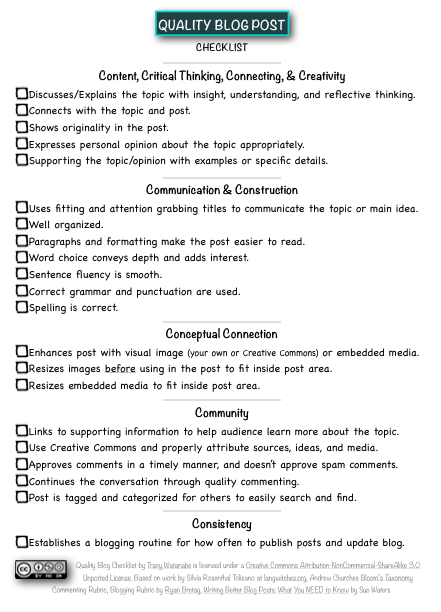
Silvia Tolisano (@langwitches) challenges us in a meme to audit blogs and comments to raise awareness of quality blogging. I'm honored that both Kathleen Morris and Sheri Edwards tagged me in this meme. Here is Silvia's meme challenge : Select a blog post or blog comment to audit (Professional or Student) Take a screenshot or copy and paste the post or comment into your blog post (be sensitive whether you want to reveal any names or references) Include or link to the rubric you use to assess the quality of post or comment Audit the post or comment by describing your train of thought regarding the level of quality you would assess your chosen post or comment Suggest how you would coach the author of audited post or comment to improve Tag (at least) three educators and challenge them to audit a post or comment Leave a comment with the link to your audit post on Langwitches Quality blog posts I created a few variations of checklists as guides for qu...

Powerful Rubrics for the 21st Century Learner

Image
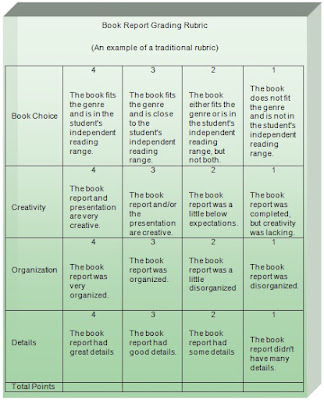
How do we make our rubrics less 20th Century and more 21st Century?  Focus on the evidence of learning and less on the product or the performance. Easily said, difficult to do. In fact, building a powerful 21st Century rubric to assess learning is an art. If made improperly, it could hinder the learner. Benefits of the Rubric Rubrics define expectations, which should be introduced to the students (and parents) before learners start working on their projects. 20th Century Rubric Flaws I will be the first to admit, I didn't know my rubrics were  flawed. Here is an example of one of mine that I used for the "book report project" that was not PBL (if this seems out of context, you may want to visit "Projects are Not PBL" ). Flaw #1 :  Don't record grades as percentages by converting the number correct out of the total number of points.  I'd take this rubric and would habitually convert it straight over to a percentage grade. For example, if...

Speak Up 2010

made on Wondersay - Animate text with style The Speak Up survey collects authentic feedback from students, families, and educators across the country. Data from prior surveys show students are primarily interested in: 1) social based learning; 2) un-tethered learning (anytime, anywhere, any device); and 3) digitally-rich learning environments. When given the question, "What is the ultimate digital textbook?", they respond favorably for interactive, relevant, and collaborative textbooks. They want the ability to search for terms easily, take digital notes on it, and to download it to their mobile devices.  They want to check for their own comprehension (like a benchmark), have learning games, online tutors 24-7, and built in accountability. In conclusion, students want learning-centered classrooms rather than teacher-centered classrooms. Our district is involved in the Speak Up 2010 survey. I had the privilege of helping in three different third grade classrooms today wi...