Posts

Showing posts with the label PLC

High-Level Thinking, DOK, and Shifts Needed in Schools
Image
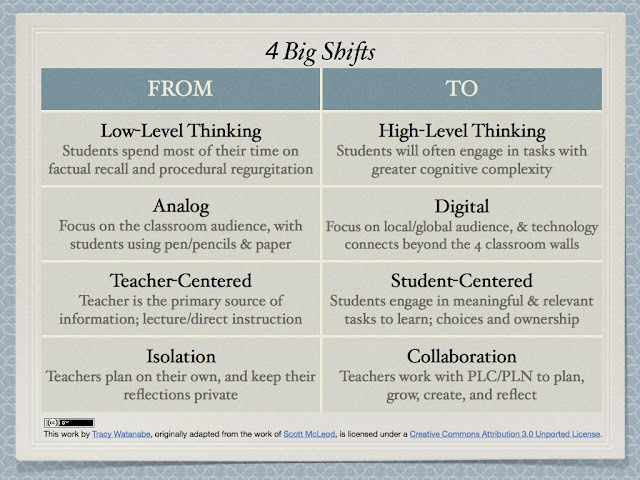
Shifts needed in schools Scott McLeod wrote a post a few months ago about 3 big shifts schools need to take. I agree with the three shifts; and want to add collaboration as a vehicle to accomplish the shifts, which is a shift in and of itself. Below is my adaptation from his original three ideas: This work, originally adapted from Scott McLeod , is licensed under a Creative Commons Attribution 3.0 Unported License. Work collaboratively to change routines What are your daily routines, and what "quick wins" can you add/substitute in those routines to plan for Depth of Knowledge (DOK) 3 and 4 questions and tasks? I like taking the standards and thinking through questions to ask students to promote deeper thinking, and products that would prove they've truly learned the content (evidence of learning). When I collaborate with others, not only does it take less time to create these questions and tasks, but it also gives me more ideas to work with, whi...

Collaboration Coaching Chronicles

Image
Today is our last Collaboration Coach Meeting of the school year, and we're celebrating all they've accomplished at their sites. Collaboration Coaching is modeled after the research-based Microsoft Peer Coaching Program , developed by the Peer-Ed Team . The training focuses on coaching and collaboration skills; best practices in lesson design and instruction; and, technology integration and engaging practices. Collaboration Coaching fosters an environment where it is safe to take risks to try innovative practices, to engage students in critical thinking, collaboration, communication, and creativity. This shift is occurring more rapidly because teachers have ongoing professional development by having someone they trust, a Collaboration Coach, who is just down the hall or right next door. Coaching Chronicles There are six fantastic "Coaching Chronicles" inside this Prezi created by the coaches at each of the schools sharing their "story" of 21st cent...

Collaboration Coaching

Image
As we wrap up our second year of Collaboration Coaching , we celebrate the success we've had with collaboration, learning with colleagues, and creating 21st century, student-centered classrooms. What is a Collaboration Coach? Our Collaboration Coaching is based on the Microsoft Peer Coach Training developed the Peer-Ed Team. We've adapted it to fit our district's needs. The Collaboration Coach training presents an opportunity for Apache Junction Unified School District teachers to explore coaching as an effective model for providing ongoing professional learning with classroom teachers focused on 21st century learning, Common Core, technology integration, and best teaching practices. Coaches receive training and support that includes methods of coaching, fostering collaboration, and action planning for successful coaching. Project emphasis infuses technology to create and promote: differentiated instruction through a variety of strategies based on student ne...

Vision, Urgency, and Measuring Effectiveness

Image
I've been involved in several discussions about leading change , which started with  vision and urgency. Everyone needed to be on the same page about the vision (the what), have a sense of urgency (the why), and know how we'd measure progress towards our goal. Having the vision relevant, tangible with benchmarks, and feedback reminded me of successful classroom practices. In the classroom, I made sure my students knew what we were learning, how it was relevant to them, how we'd measure progress towards our goal (the what, why, and how), and involved them in the process. I realized leading change had some of the same foundations, such as starting with the vision. Vision In order to be purposeful about change, the vision for what is wanted must be clear by everyone. If I asked, "What does it mean to be a 21st century, student-centered school district?" the answer must be clear in the minds of everyone. It must be clear to the administration , the teachers, ...

Lead, Coach, and Build Capacity

Image
Building capacity in the school district means improving and strengthening the learning in our students, employees, teachers, administrators, school board, and community. Coaching is a great way to build capacity, and leaders naturally build capacity. Finding leaders to assume leadership roles is an important part of the process. Please be aware that I don't believe a title makes someone a leader, it's just who they are. Leadership skills sets I've recently been involved in several conversations about building capacity. One of the conversations was about skills sets to look for when identifying leaders, specifically coaches.  I believe the following qualities are found in good coaches and leaders: People person : gels well with others and builds relationships Character: has integrity and is trustworthy Attitude: is positive even in negative circumstances Skills and productivity : able to get things done 21st century thinker : adapts, problem solves, is creativ...

Formative Assessment and Differentiation

Image
Formative assessment informs educators about student learning, and when done correctly, it also informs the students how to improve and move forward with their next goal. Teachers must know how to use that information to shape their instruction. We use formative assessments to drive instructional decisions such as changing the approach or changing the target content. Created with Doodle Buddy , prompted by Stem Resources visual Differentiating assessment and instruction I spent February 10th with the awesome staff at Apache Junction High School facilitating staff development . While talking about differentiating assessment and instruction , we addressed the importance of adjusting our teaching style to their learning style . For example, I'm an exceptionally visual person, and like to synthesize and put concepts together in pictures such as the one above. In school, I enjoyed geometry and calculus, but struggled in Algebra II. In fact, I took calculus as my fun electi...

Coaching and Professional Development Midyear Reflection

Image
This post is my reflection (and brainstorm) for creating a 21st century learning district, specifically through developing our Collaboration Coaches . I’m asking for your feedback. The focus for Year 2 Collaboration Coaches This is the second year we’ve had Collaboration Coach training in the district. The first year training module is closely adapted from Microsoft Peer Coach Training developed by the Peer Ed Team. Since there isn’t a continuation training module, I’ve created my own based on surveys, reflections, and four areas of focus: Communication, collaboration, and coaching skills  21st century learning, pedagogy, and lesson design Best practices with technology integration and resources Staff development The professional development plan for Year 2 Collaboration Coaches August : Setting goals and overview of year -- for the purpose of kicking off the year September : Web 2.0/Coaching Smackdown   -- focusing on best practices; resources; and ideas for...

Grow a Learning Culture through Peer Coaching

Image
Teching it Up K-12 -- Success Stories, Part 2 In Part 1 of "Teching it Up K-12 -- Success Stories," originally presented at the Arizona CIO/CTO Forum 2011 , we focused on the importance of a learning-centric vision. Our focus for Part 2 was developing a learning culture through peer coaching . Serving others through Peer Coaching With all the professional development needed to sustain one-to-one, PBL, 21st century learning, and individualized instruction, we turned to the Microsoft Peer Coaching model developed by the Peer-Ed team. The beauty of Peer-Ed's training modules was the adaptability to our district's vision. To highlight the "collaboration" role of peer coaches, we called them "collaboration coaches." Collaboration Coaching, Catalyst for Culture Shift We tapped into full time teachers as our collaboration coaches. They focused on creating a 21st century learning environment in their own classrooms, while also working ...

Our first Web 2.0 Smackdown

Image
After experiencing the EdubloggerCon ISTE 2011 Web 2.0 Smackdown , I knew I wanted to see this in our district during professional development. To add to that idea, I read a post by Patrick Larkin , Burlington High School Principal, about their flipping the Smackdown to the beginning of their Professional Development as a preview for their breakout sessions. Our Collaboration Coaches , are just the people to introduce this idea to. They are passionate learners, collaborators, and focus on creating student-centered classrooms. Our version of a Web 2.0 Smackdown Any participants could share whatever tools/resources connecting to lesson improvement, coaching skills, or tech integration. The process: Submit topic and link to your visuals before we meet (collected in a Google Form). On the day we meet, present for 2 minutes live or show a recorded "trailer" for us. After smackdown, we'll vote for one to learn more about. Tools and Resources Here's what th...

Beyond 4 Walls -- Building PLN

Image
I'm filled with excitement as we move beyond the four walls of our classroom to build our Personal Learning Network (PLN). What is a PLN? Watch this fabulous 2 minute interview of Steven Anderson explaining the difference between a PLC and PLN, and its power. Our Growth In the past year, almost 70 AJUSD educators joined Diigo to start sharing resources. Approximately 100 AJUSDers subscribed to blogs in Google Reader , and roughly 30 educators started Twitter accounts, including me . One-to-One We started moving to a one-to-one environment at Cactus Canyon Junior High (CCJH). Our professional development (PD) throughout the year focused on pedagogy, which naturally included differentiating instruction with technology. Therefore our PD modeled our beliefs. Skype Beyond 4 Walls When we focused on engaging students with authentic purpose, we discussed blogs. There were three PD options for our CCJH educators tiered to their needs. Since this is so new to u...

Reflection of a Peer Coach Facilitator

Image
I learned so much this year about what it takes to launch and sustain success in peer coaching . We wanted to highlight the "collaboration" needed in successful peer coaching; hence we don't call them peer coaches, but rather "Collaboration Coaches." From the Beginning Our district made the decision to tap into teachers who naturally collaborated with colleagues, engaged kids with 21st century thinking, and created student-centered classrooms. The idea was to train them so their strengths became even stronger. Why Collaboration Coaching Peer Coaching was sponsored by Microsoft on Microsoft's Partners in Learning Site. The facilitator training by Peer Ed' s Shelee King George was superb, and it provided me with a tried and true floor plan for training others. We took that training and blended it with our District Vision and Plan . The training builds skills to foster the culture of collaboration because there was an expectation for collaborati...

Innovative Learning in High School

Image
This is the second post in a three part series to highlight some awesomeness, and to ask for others to share or provide more ideas. Coaching Chronicles The following Coaching Chronicles was created by our High School Collaboration Coaches as their reflection on the 2010-2011 school year. Collaboration Coaching at AJHS has allowed us to better use our instructional time and resources to effectively engage and inspire students. Through training sessions and frequent interactions, we have been able to share ideas, receive encouragement, and seek guidance on lesson plans. In looking forward we anticipate creating a stronger support system, increasing student achievement and accountability, and discovering resources to better teach 21st Century skills. Created by Elizabeth Francois, Sandy Rollefstad, and Jerry Paterson. What I appreciated was their understanding for collaborating and building professional learning communities. Prezis spread like wildfires in the classroo...

Great Leaders Focus and Build Teams

Image
Forbes blog post, " Suddenly Noticed By Big Investors, Kevin Tanner's RIA Is Bracing For Billions Of AUM ," caught my attention as I thought about educational leadership. Kevi n Tanner focused on his strengths and passions. "He was never as interested in financial planning and spent his time perfecting his investing methodologies ." He wasn't co ntent with running things the way others did just because that's how it's always been done. Great Leadership Great leaders invest in their strengths and imagine the possibilities. Great leaders see where they are going, plan for it, remain focused on the goal, and know how to develop others. John Maxwell , author of The 21 Irrefutable Laws of Leadership , describes this as "the law of navigation ." The fear of change doesn't hold back great leaders because they intuitively strategize and plan for success. They value the strengths of others, and recognize that building other leaders a...

One-to-One Success Story Tip #1 about P.D.

Image
Recently I read a post by Nick Sauers titled, "Common frustrations with one-to-one ." He found that those who were frustrated with one-to-one had issues with lack of professional development, and weak infrastructure. To his second point, I have to say kudos to our Tech Department because I don't know of any infrastructure issues because everything was exceptionally planned out. To his first point, I have learned a lot about the professional development needed in a one-to-one environment. Adjusting the Professional Development I had been training them in one swoop -- so one training of this or one training of that. Those who were tech savvy, needed that one time of show me the basics and I'll figure the rest out on my own. Well, that was the minority. There were several who would ask me some basic questions about technology integration, and it became clear to me what needed to happen. They needed small doses over a continued amount of time. Ongoing, Small ...