Posts

Showing posts with the label blog

My #HackEd2014 Summary and Reflections

One of my favorite conferences is ISTE Unplugged / Hack Education . The schedule of the discussions is decided the day of the conference based on the interests of the participants. What is appealing to me about Hack Education is the small group setting that fosters deep discussions, and the organic nature of the conversations that are completely based on the group's expertise and ability to ask probing questions. I always feel like I walk away smarter. My notes for some of the sessions are illustrated below as sketchnotes with thinglinks/interactive links, bullet points, or as the main points I Tweeted out. Personalized Learning - facilitated by Barbara Bray Click here to view above image with thinglink 1:1 Deployment Click here to view above image with thinglink Smackdown Official HackEd Smackdown sharing. Tracy's HackEd Smackdown notes. Community, Global Connections using tech to build relationships Click here to view abov...

Writing 2.0: Technology-Rich Approach to Common Core Writing

Image
What skills are most desired by employers? On most lists , communicate effectively is the number one desired skill. How do we communicate? We communicate face-to-face, in writing, through various technologies, and multimedia. What is does it mean to be literate? Being literate is being able to effectively communicate. Therefore, every classroom must teach digital literacy as part of literacy, and not something separate. Original image by Andrea Hernandez Why have technology-rich writing? Writing is a huge piece of literacy. Writing should occur across content and grade levels. Common Core writing requires students to create and publish writing online, and to interact and collaborate with others. Writing Anchor Standard #6 : Use technology, including the Internet, to produce and publish writing and to interact and collaborate with others. We must design lessons that incorporates digital mediums for students to communicate and collaborate with others. "(St...

21st Century Literacy, Communication, and Blogging

Image
What does it mean to be literate? Traditionally, being literate meant the ability to read and write, a trademark of being educated. In essence, it meant the ability to communicate face-to-face and in writing. The Internet has changed what it means to be literate because communication; writing; and how we retrieve, share, critically evaluate, and synthesize information includes digital fluency, which requires a new set of skills . Originally adapted from: opensourceway via Compfight cc The development of this new skills set affects online reading comprehension and literacy ( Coiro, 2007; Leu et al., 2005; Leu, Zawilinski, et al., 2007 ). Those who harness the power of the Internet have increased reading comprehension online relative to those who lack online reading skills regarding locating, critically evaluating, synthesizing, and communicating information ( Coiro, 2011 ). Therefore, we need to change how we teach literacy . Literacy must include sophisticated Inter...

My #ISTE12 Reflection, Part 1

Image
What had the most impact on me this past week, and what memories will be most prominent from this week? What new goals will I set as a result of this week? Here they are, not in any particular order. Linda Yollis & Kathleen Morris 1. Educational Blogging: Flattening Classroom Walls by Linda Yollis and Kathleen Morris I am always inspired and in awe of these two women. They have made such an impact on me, so to see them present together live was absolutely incredible, especially since this week was the first time they had met face to face! Their stellar session was filled with powerful tips, incredible resources , while providing powerful examples of what can evolve out of blogging. To highlight a few tips: Linda , Kath , Sue Wyatt , Sue Waters , me , Ronnie , Julie , Anne , John Start small. Blogging is a journey. Use your content objectives to focus your posts. This way blogging doesn't become an add-on to try to fit in, but rather part of your literacy bloc...

Quality Blogging and Commenting Audit Meme

Image
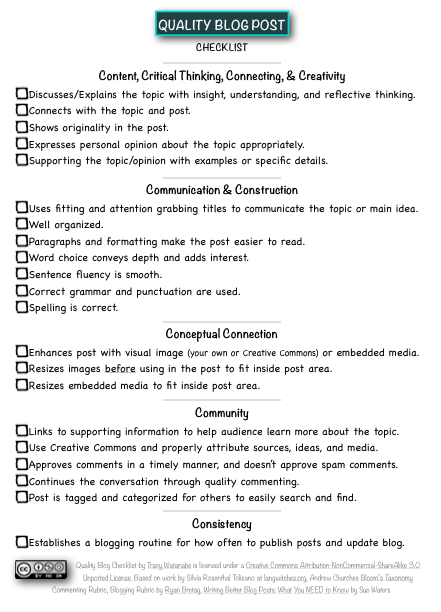
Silvia Tolisano (@langwitches) challenges us in a meme to audit blogs and comments to raise awareness of quality blogging. I'm honored that both Kathleen Morris and Sheri Edwards tagged me in this meme. Here is Silvia's meme challenge : Select a blog post or blog comment to audit (Professional or Student) Take a screenshot or copy and paste the post or comment into your blog post (be sensitive whether you want to reveal any names or references) Include or link to the rubric you use to assess the quality of post or comment Audit the post or comment by describing your train of thought regarding the level of quality you would assess your chosen post or comment Suggest how you would coach the author of audited post or comment to improve Tag (at least) three educators and challenge them to audit a post or comment Leave a comment with the link to your audit post on Langwitches Quality blog posts I created a few variations of checklists as guides for qu...

21st Century Learning & Writing

Image
The #elemchat on Dec. 17th, focusing on strategies and approaches for helping students become better writers , got me thinking about what writing looks like in 21st century learning. What does 21st century learning look like? Some rights reserved by sntgmdm Students engaged in authentic task Students are collaboratively problem solving Collaboration -- students helping peers Students are creating original work to represent their ideas Teacher is walking around the room facilitating Noticeable routines and procedures for getting help and transitioning Learning is interactive and engaging Students are on task and taking risks to learn Students are forgetting they're learning Ongoing assessment/feedback/reflection All of the above can be with or without technology What does 21st century learning sound like? Teacher facilitating instead of directing Focused noise--it's not silent while they are on task Student led discussions Respectful discussions a...

Tracy's Nominations for the 2011 Edublogs Awards

Image
I love awards because it's a chance to recognize and share those who rock my world. Thank you Edublogs for providing this opportunity to acknowledge amazing educators around the globe, and for raising the awareness of the awesome impact social media and web 2.0 can have on our learning and our learners. Here are my nominations for 2011-2012: Best individual blog: Integrating Technology in the Primary Classroom Integrating Tech in the Primary Classroom Hands down, the most influential individual blog that I've learned the most from is Kathleen Morris' Integrating Technology in the Primary Classroom . Her content is innovative, filled with tangible and applicable learning for every level (even if you aren't a primary teacher). She makes it super easy for a newbie to feel right at home, while being encouraged to take the next step. I appreciate how Kathleen replies to all her comments, which lets us know how much she cares and is passionate about helping ...

Collaborative Writing to Develop the 21st Century Learner

Image
Collaborative writing is strong for bringing ideas together, capitalizing on individual strengths, and building in feedback. When I walked into Mrs. Bliss' 5th grade class to work on the Student Blogging Challenge #3 , "Me on the Internet," they decided to write their post collaboratively. How can students successfully write a collaborative post (or written work)? Build Background Knowledge (while hooking their interest) First, we watched this video called Digital Dossier by DigitalNatives , introduced to us in Miss W's post for the Edublogs Student Blogging Challenge #3 . Before playing the video, we asked them to focus on two questions to discuss after the video: What is a Digital Dossier? Why is it important to each one of us? Following the video, we went back to our guiding questions and asked them what it was and why it's important. The students were quite involved in their discussions because of its relevance to their lives. Introducing Trac...

Common core, informational text, digital literacy, & 21st century learning

Image
Last week, I had the privilege of working with a group of educators on 21st century lessons and PBL as part of their Collaboration Coach training. One of the main topics we kept revisiting was authentic purpose and audience. After pointing out strengths, I asked questions such as: What real audience could the students share their learning with? What real audience would benefit from their learning/product? What real audience, community, or expert outside the classroom could provide feedback? Relating Authentic Purpose and Audience to Common Core Language Arts Yesterday I received an email from Theresa Bartholomew , our Federal Programs Director, asking us to watch this video and reflect on these questions: What stands out to you about this?   What potential shifts will this require in our instructional time, focus, use of curriculum programs, etc.? Here was my quick reply to Theresa: I'm pumped about it! I expect to see more PBL , probably thematic units , an...