Posts

Amplify Voice through Social Media #CUE18

Image
Giving students a platform to exercise their voice, and listening to learn and understand, makes an impact on learning, academic discourse, class/school/district culture and climate. Some of the highlights and resources gained from learning with @JoeMarquez70 's at #CUE18 , includes: Digital Citizenship -- address this daily Invite a Guest Moderator to the backchannel  Back Channel Tools Today's Meet ZiteBoard AwwApp Class Hashtag Collaborating, Learning Artifacts, Annotating Tools Google Classroom in conjunction with qbbuzzer Google Sites Flipgrid Perusall Edji YouTube with Vialogues NearPod Connect with the world beyond the four walls: Note: I am sharing some resources and successes from Joe Marquez, and please understand that I have not vetted the privacy policies for AB 1584 compliance   yet .  What are some other success stories of amplifying student voice? How else might we promote academic discourse? 

Fake News and Visual Literacy #CUE18

Image
Fake news is not accidental reporting with a few mistakes, it is intentional and designed to look real. According to Dr. Lesley Farmer , of California State University at Long Beach,  the motivation behind creating fake news is often to profit, gain influence, assert power, and sometimes to entertain. As critical consumers and responsible contributors, we should be skilled in  discerning validity and disseminating reliable information. Images, like all text, communicates a message. Hence, we are to "read" the visual and glean meaning grounded in evidence.  However, we might not retain the objectivity to critically evaluate the message when strong emotions skew our perception. When a communication reinforces or challenges our core beliefs, it might blind us from objectively stepping back to ask questions such as, "What's the narrative? Who is communicating it, and why?" California's ELA/ELD Framework explicitly draws attention to the broader topi...

Global Collaboration

Image
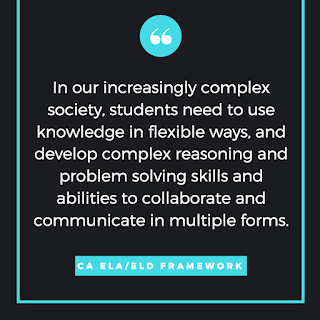
In order to prepare students to apply rigorous learning to new and real-world situations, educators must provide opportunities that foster critical and creative thinking, communication and collaboration. Importance of Global Collaborations Common Core State Standards demand students to collaborate with diverse partners , thereby expanding students' global awareness . Some of the benefits of collaboration might include: Developing interpersonal skills of working together as a team. Fostering critical thinking skills while working towards a collaborative goal. Increasing comprehension while partaking in conversations and exploring ideas from different perspectives. "Collaborative learning promotes communication among students; it is particularly beneficial for English Learners (ELs) because peer interaction contributes to the development of language," ( CA ELA ELD Framework, Chapter 2 ). New 2016 ISTE Standards for Students I recently attended th...

Urgency with Coding Now for the Future

I've heard Anne Jenks share numerous times the importance of teaching coding in school, especially with so many STEM professions available . If computer science careers are the number one source of jobs in the US, then we should have more computer science graduates, and therefore more coding/programming opportunities in K-12 classrooms. Urgency with coding in classrooms now for jobs in the future #cue16 #gccue pic.twitter.com/oDGiOX7M7d — Tracy Watanabe (@tracywatanabe) March 17, 2016 The time is now to start teaching digital fluency and coding as part of literacy. Being literate in today's world, includes computer literacy. Luckily, there are organizations, such as Code.org , dedicated to giving students opportunities to learn computer science. How do you get started? Below are a few places for getting started: Device Elementary Secondary iPad Daisy the Dinosaur Tickle  (older app) Hopscotch Scratch Jr. Cargo-Bot Tickle Laptop/Desktop Scra...

Google Classroom 101

Image
Google Classroom integrates Google Apps for Education (GAFE) tools such as  Google Docs, Gmail, and Google Calendar to name a few. It then allows the teacher to distribute and collect assignments paperlessly. Google Classroom with iPads too Google Classroom is not just for Chromebooks, it's a useful management tool for other platforms such as iPads as well. For instance, one great way to collect student creations and manage the workflow on iPads is through Google Classroom. What is Google Classroom and how does it work? Why should I consider Google Classroom? Here are a few reasons why Google Classroom should be considered: It helps organize discussions, assignments, projects, or assessments online. Classroom helps students organize their projects, assignments, tasks, etc. and keep track of upcoming assignments, or assignments already turned in and teacher feedback or grades. Classroom could foster communication. Classroom saves time, especially when working with Go...

QR Codes in the Classroom

Image
QR (Quick Reader) Codes are like bar codes to quickly connect you to text, websites, audio clips, videos, etc. QR Code Reader The device will need a QR Code Reader. My current favorite is still i-Nigma   because I've found that audiences typically do not need to leave their seats to scan the QR Code from the screen I'm presenting from, while other readers have not been as reliable. i-Nigma Available on IOS Available for Android Available on Blackberry Available for Windows   There are also QR Code Readers for Chromebooks and other devices that have cameras. QR Code Generator There are several ways to create QR Codes, however my current favorite is GOQR.me . Below are the instructions for two different ways to use it: Using QR Codes in the Classroom There are many ways QR Codes can be used in the classroom beyond quickly viewing a website. Some ideas and more resouces are listed below: From Tom Barrett's work,  40 Interesting Ways to use QR ...

Deeper Thinking and Revised DOK Flowchart

Image
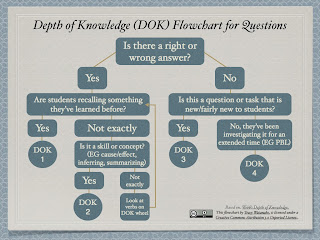
About a year or two ago, I noticed my DOK Flowchart floating around Pinterest . I didn't think much of it because the thought process behind the flowchart was documented on my post titled, Striving for Higher-Order Thinking and Depth of Knowledge . This flowchart was created to help teachers in my former district categorize their own questions by DOK level, to look for patterns and trends, in order to set goals regarding their quest for deeper thinking. It was a flowchart that worked with many question patterns we commonly saw, but was not intended to be definitive. For example, when it came to a question in math, we knew there was a right and wrong answer -- for example, 3X4=12. However, we considered how there were multiple approaches to get to that correct answer. While, that was a discussion we had face-to-face, my original flowchart did not reflect those conversations. Therefore, I revised the flowchart to help clarify: Click here to download as PDF. Below are ...