Posts

Analogies, Visual Representations and Metaphors for DOK
Image
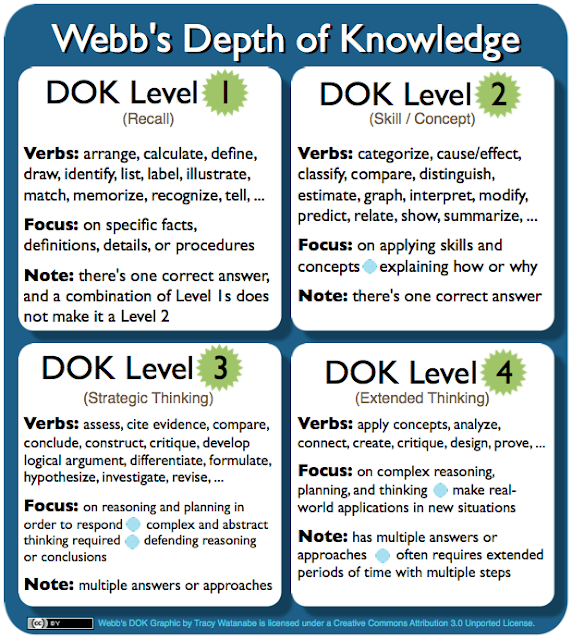
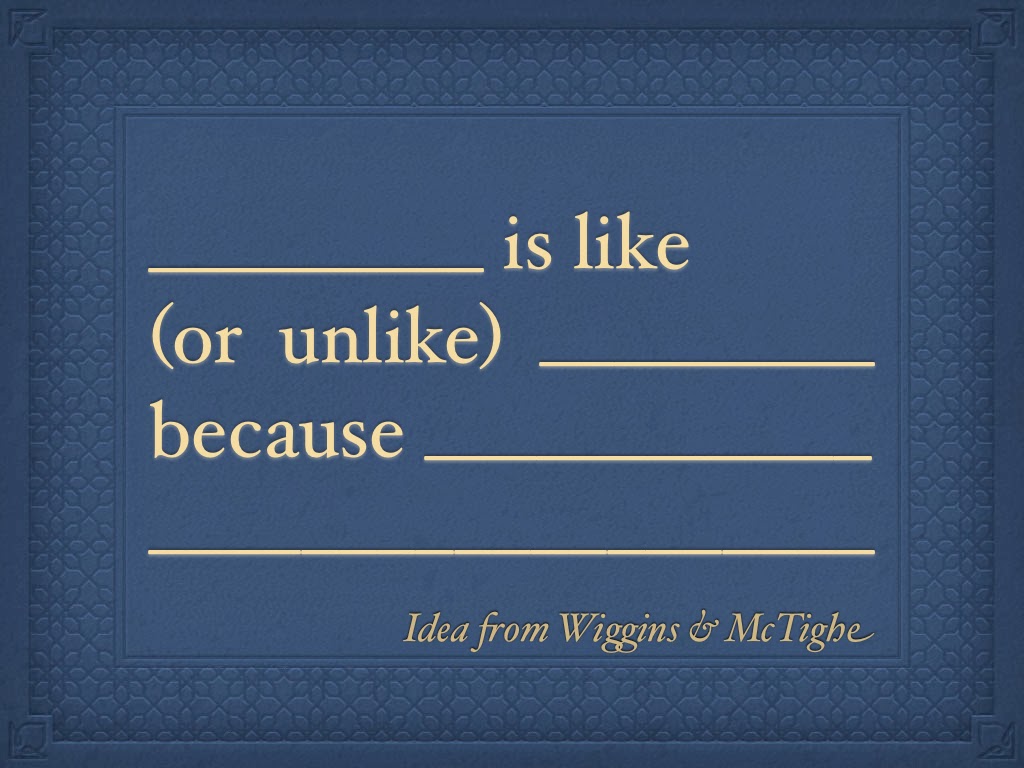
Our teams are focusing on creating rigorous learning activities by applying Webb's Depth of Knowledge (DOK) Level 3 and 4 tasks . "Webb developed four DOK levels that grow in cognitive complexity and provide educators a lens on creating more cognitively engaging and challenging tasks," ( New York City's Department of Education ). By focusing on DOK 3 and 4 levels, they are providing opportunities for students to engage in rigorous thinking as they connect with the content. This post will focus on analogies, visual representations, and metaphors as avenues for creating engaging DOK tasks. Analogies Analogy prompts are great ways to check for understanding (Wiggins & McTighe in UbD), and they are DOK 3 tasks. This can be done with any content area. Here are a few examples:  Finding the line of symmetry is like finding a matching shoe because both sides are now the same size and same shape. Spelling correctly is like washing your hands after usin...

Digital Storytelling and Stories with the iPad

Image
Digital storytelling is an art form conveying a message. It uses images and voice narration to convey emotion with the message, and to ignite empathy from the audience. It incorporates storyboarding and writing a script. It is created with digital tools and published on the Internet. I often think of digital storytelling as something done in first person because it creates that personal connection. Whereas, I think of a digital story as an anecdote or story typed or narrated in third person. Image attribution: Lyn Hilt's Slideshare , used with permission. Original work: "Writing- Pen & Paper" CC-by Laurie Richie Benefits Here are some of the many benefits of digital storytelling and digital stories: The 21st century skills and ISTE's Standards  applied are critical and creative thinking; written, oral, and digital communication; collaboration; authentic learning; digital fluency...

Creating DOK 3 and 4 Tasks

Image
This morning, I saw the "light bulb" illuminate as a team realized that Webb's Depth of Knowledge Level 3 (DOK 3) tasks aren't more "difficult" problems, but rather it's when students engage with content learning at deeper cognitive levels. The team recognized: Even if the teachers ask higher level questions, student responses to the questions and what they "do" (the task) is what determines the Depth of Knowledge (DOK) . DOK 3 can be quick activities, and often times it's just taking the lesson one more step. How does DOK 3 impact teaching fundamentals? The skill the students are working on doesn't determine the DOK . It might be a fundamental skill, yet can engage with it at deeper cognitive level. For example, it might  be a fundamental skill such as memorizing sight words, but then have students interact with the words such as creating a presentation for quizzing themselves on the words, or writing sentences using thei...

High-Level Thinking, DOK, and Shifts Needed in Schools

Image
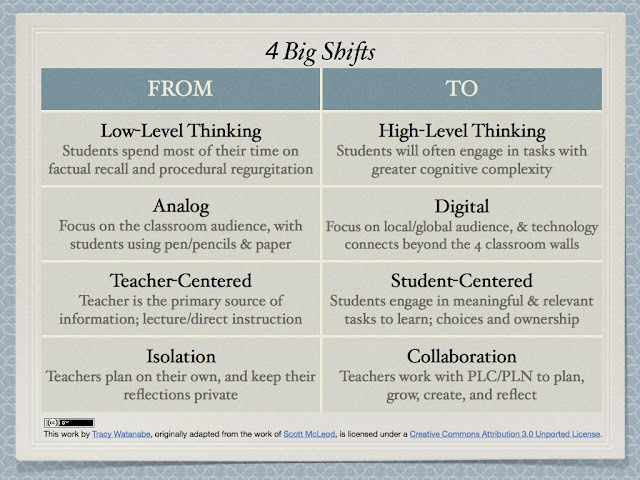
Shifts needed in schools Scott McLeod wrote a post a few months ago about 3 big shifts schools need to take. I agree with the three shifts; and want to add collaboration as a vehicle to accomplish the shifts, which is a shift in and of itself. Below is my adaptation from his original three ideas: This work, originally adapted from Scott McLeod , is licensed under a Creative Commons Attribution 3.0 Unported License. Work collaboratively to change routines What are your daily routines, and what "quick wins" can you add/substitute in those routines to plan for Depth of Knowledge (DOK) 3 and 4 questions and tasks? I like taking the standards and thinking through questions to ask students to promote deeper thinking, and products that would prove they've truly learned the content (evidence of learning). When I collaborate with others, not only does it take less time to create these questions and tasks, but it also gives me more ideas to work with, whi...

Striving for Higher-Order Thinking and Depth of Knowledge

Image
A little over a year ago, I read Higher-order thinking is the exception rather than the norm for most classrooms on Scott McLeod's blog, Dangerously Irrelevant , and have been mulling it over, wondering if our school district is any different. Over the past year, our teachers periodically collect data with their teams on the types of questions/tasks they ask students. One teacher records teacher questions and the other records student responses on a shared Google Doc ; then teams sort through their own data, plotting teacher questions by Bloom's Revised Taxonomy , and student responses to those questions/tasks with Webb's Depth of Knowledge (DOK) . The 2012-2013 data showed we were not very different from other districts; therefore, our teams set their own goals for higher-order thinking and depth of knowledge. The data so far for the 2013-2014 school year shows questions asked of students are up and down the Bloom's ladder, equally distributed (with a little...

Nominations for the 2013 Edublog Awards

Image
The purpose of the Edublog Awards , or Eddies, is to raise awareness of educational blogging and social media for learning. Image Credit: Edublogs Here are my nominations: Best individual blog -- Mrs. Yollis' Classroom Blog ( Linda Yollis ) Best group blog -- Cougar News Blog (authored completely by 7th & 8th grade students, with the guidance from Journalism Teacher Jason Davis ) Best new blog -- Salsich Team 5 ( Jonah Salsich 's Class Blog) Best class blog -- Mrs. Hamman's Class Blog (posts are mainly written by the students) Best student blog -- Em's Canvas (2nd grade student) Best ed tech / resource sharing blog -- Langwitches ( Silvia Rosenthal Tolisano ) Best teacher blog -- EdTech Workshop ( Andrea Hernandez ) Best library / librarian blog -- Bulldog Reader's Blog ( Julie Hembree ) Best administrator blog -- This and That ( Jon Castelhano ) Most influential blog post of the year -- My TEDxDesMoines video: From Fear to Emp...

Self Selected Professional Development

Image
Original Photo Credit: 96dpi via Compfight cc     Adapted by: Tracy Watanabe cc Twitter Chats are fabulous self-selected professional development. A Twitter Chat Group is a group of people who come to Twitter to "discuss" a specific topic of interest. During the Twitter Chat, moderators will ask questions around the topic, and participants will answer. It requires some fast thinking to respond and read other responses. Every Twitter Chat I've been part of has given me new ideas/resources, affirmed other ideas, and/or motivated me to follow through with the next step. For example, the recent discussion on Connected Principals Twitter Chat , #cpchat, discussed how principals (and administrators in my case) can use Twitter to help connect educators. How can districts give Professional Development credit for Twitter Chats? I've grappled with this idea for a few years and believe I've come up with a solution that would work in my school district. ...