Posts

Comments for Community to Enter a State of "Flow" #C4C15

Image
According to Mihaly Csikszentmihalyi, happiness and genuine satisfaction comes from a state of consciousness called flow . To achieve flow, one must be completely absorbed in an activity, a mindful challenge, involving creativity. Those mindful challenges can not be too demanding, nor too easy. This "mindful challenge" reminds me of a volleyball net. If it is set too high, it is too difficult to hit the ball over the net, resulting in giving up the game out. Likewise, if the net is too low, there's not enough challenge to keep my attention, leading to the same outcome of giving up the game. Thus, we need to set the net at the appropriate height, and then we'll start learning how to make changes to improve, which is when we'll become intrinsically motivated by the act. “Most enjoyable activities are not natural; they demand an effort that initially one is reluctant to make. But once the interaction starts to provide feedback to the person's skills, i...

What does it mean to be literate in the 21st century?

Image
There's not a doubt in my mind that technology has changed our world. Information is created, shared, and evaluated differently. People connect, communicate, and go about their daily lives in new ways with the use of technology. Think about the impact of technology on industries like newspapers, publishers, movies, travel agencies, etc. I go online to read the news, view books, and watch movies. I plan vacations, make travel arrangements, and purchase tickets online. I find new recipes and share them with friends through social media. We are in an information revolution. It's changing and disrupting how things are done, and requires new skills to be successful. Therefore, it impacts what it means to be literate, moving beyond reading and writing and into information and digital literacies. New literacies Today, students need to be taught information and research fluency , along with digital citizenship and technology operations and concepts . Click here to ...

Screenshots

Image
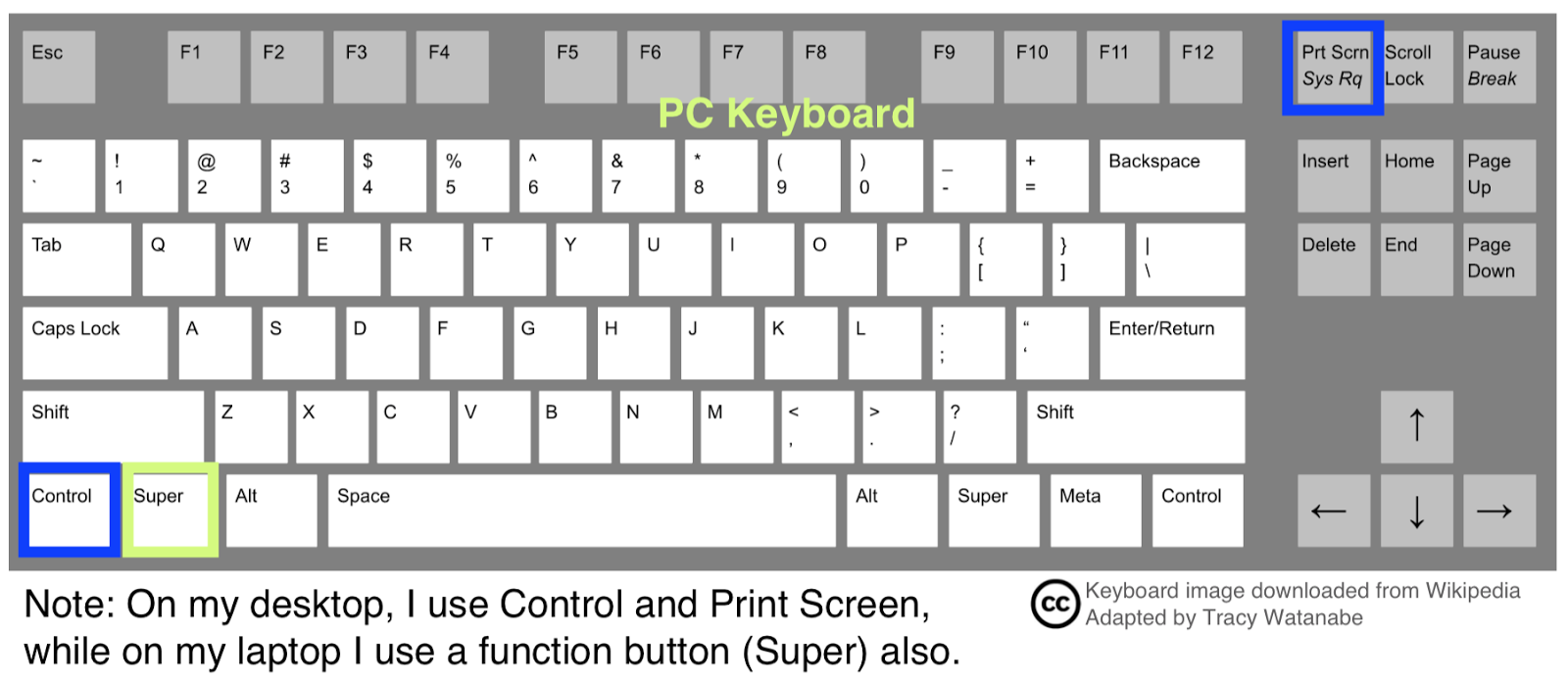
One question I'm asked on occasion is, "How do you capture a copy of what's on your screen?" The procedure differs a little depending on the device. The devices I most frequently use are listed below. On PCs, this is often how I'd do it: Press the “Print Screen” key on the top right of my keyboard. Then open my email, PowerPoint, or Paint. Press CTRL + V to paste the image. Decide if I need to save the image (or crop the image). If so, I like using Paint. On my Mac, I'll: Press Command, Shift, and 4 at the same time. Then pull the crossbars down and around the image you want to capture. You’ll find it on your desktop as a Screenshot. On an iPad, I'll: Press the sleep button and the home button simultaneously. It will save in the Camera Roll album (see icon below). Final thoughts Screenshots are valuable when creating presentations or explaining something from the screen. For example, if there is an error message...

14 Best or Worst from 2014

Image
As I reflect on 2014, I want to share 14 of the best and some of the worst from 2014. 1) Most acknowledged blog post -- Mystery State Skype I received the Editor's Choice Content Award from SmartBrief for my post on the Mystery State Skype. I also had the opportunity to talk with  by Larry Jacobs on  Education Talk Radio  -- ( click here to go straight to archive of radio show). 2) Most visited blog post  --  Digital Storytelling and Stories with the iPad 3 & 4) My favorite post -- Harnessing Powerful Ideas: Leading One-to-One This post was my favorite to write because it helped me collect many ideas about one-to-one, and place it in one space -- my post. Furthermore, I absolutely loved creating the graphics for this post. It was my first experiment with using Canva . 5) Favorite new(ish) tool  (besides Canva) -- Pinterest While Pinterest isn't new, it so happened to be new for me. I had an account before 2014, but it was dur...

Formative Assessment with Plickers

Image
Formative assessment helps teachers make data-informed decisions to plan for and/or adjust instructional activities, identify potential misconceptions, monitor the pace of instruction, etc. While there are many ways to formatively assess students, I recently saw  Eric Sheninger use Plickers during his workshop at the Ventura County Office of Education, and thought, what an easy and inexpensive way to quickly assess groups! . @E_Sheninger Using Plickers #l3vcoe pic.twitter.com/rEHcTMgNKb — Tracy Watanabe (@tracywatanabe) November 7, 2014 Purpose and benefits Collect data from multiple choice or true/false questions from a group. View data as a group snapshot in a graph, or view individual data from audience. Quick, low-tech tool to use, especially when you don't have the budget for clickers. Technology and prep Teacher/Facilitator creates an account at Plickers . Download app for portable device: iTunes or Google Play . Print out a set of reusable  car...

Mystery State Skype

Image
Mystery State Skype isn't a new idea, it's basically taking learning geography and placing it in a game format like Twenty Questions via Skype, by asking questions to guess the location of the other classroom. Not only does this connect students from across the country (or globe), but it also gives a context for students to apply geography with critical reasoning, collaboration, communication, digital citizenship, and information fluency -- 21st century skills . Skype in the classroom Learning standards What should your students research? I recommend looking at your standards to know what is expected of your students as a starting place. Geography standards --  History-Social Science Content Standards   Consider the research writing standards (see CCSS ELA Writing Standards #7 - 9 ) Converse and collaborate with diverse partners -- CCSS ELA Speaking and Listening #1 21st Century Skills -- ISTE Standards for Students Note that your students will read information...

Formative Assessment and Google Forms

Image
Formative assessment informs educators about student learning, and when done correctly , it also informs the students how to improve and move forward with their next goal. Teachers must know how to use the data to drive their instruction. Formative Data by Tracy Watanabe - Created with Haiku Deck, presentation software that inspires Gleaning results from the data and providing specific feedback must be timely, which is why I like using Google Forms (along with other tools). Why Google Forms While there's a plethora of tools that can be used to collect formative data, I am going to focus on Google Forms. Google Forms is an awesome time saver for collecting data in surveys, assignments, mindsets, exit tickets, etc. It aggregates the data collected into a Google Spreadsheet, and gives me a summary of the data in nice graphs as well. For example, below is a Google Form used by a high school teacher. He told me that this tool is a time saver because he can quickly se...
