Posts

Writing 2.0: Technology-Rich Approach to Common Core Writing

Image
What skills are most desired by employers? On most lists , communicate effectively is the number one desired skill. How do we communicate? We communicate face-to-face, in writing, through various technologies, and multimedia. What is does it mean to be literate? Being literate is being able to effectively communicate. Therefore, every classroom must teach digital literacy as part of literacy, and not something separate. Original image by Andrea Hernandez Why have technology-rich writing? Writing is a huge piece of literacy. Writing should occur across content and grade levels. Common Core writing requires students to create and publish writing online, and to interact and collaborate with others. Writing Anchor Standard #6 : Use technology, including the Internet, to produce and publish writing and to interact and collaborate with others. We must design lessons that incorporates digital mediums for students to communicate and collaborate with others. "(St...

Chromebooks, Chrome Web Store, and Add-Ons

Image
There's a lot more to Chromebooks and Google than meets the eye! I've been learning as much as I can about Chromebooks, the Chrome Web Store, and Add-Ons since we are a Google Apps for Education district and have Chromebooks as our One-to-One devices at our high school, and have many carts at our other campuses.  How are Chromebooks different? Chromebooks have a web based management council. This means they: update themselves; boot up in less than 10 seconds; cannot have software installed on them; can install apps and extensions through the Chrome Web Store (including a plethora of Educational Apps); can do most anything online via the Chrome browser; and, start up by logging onto the computer with their Google password, then straight into Chrome. What do we need to know about the Chromebook hardware? There are different types of Chromebooks. The one we are using in our district is the Samsung . They are light (2.42 pounds) and have a battery life of approx...

21st Century Literacy, Communication, and Blogging

Image
What does it mean to be literate? Traditionally, being literate meant the ability to read and write, a trademark of being educated. In essence, it meant the ability to communicate face-to-face and in writing. The Internet has changed what it means to be literate because communication; writing; and how we retrieve, share, critically evaluate, and synthesize information includes digital fluency, which requires a new set of skills . Originally adapted from: opensourceway via Compfight cc The development of this new skills set affects online reading comprehension and literacy ( Coiro, 2007; Leu et al., 2005; Leu, Zawilinski, et al., 2007 ). Those who harness the power of the Internet have increased reading comprehension online relative to those who lack online reading skills regarding locating, critically evaluating, synthesizing, and communicating information ( Coiro, 2011 ). Therefore, we need to change how we teach literacy . Literacy must include sophisticated Inter...

Craft and Structure, Deeper Thinking, and Tech Integration

Image
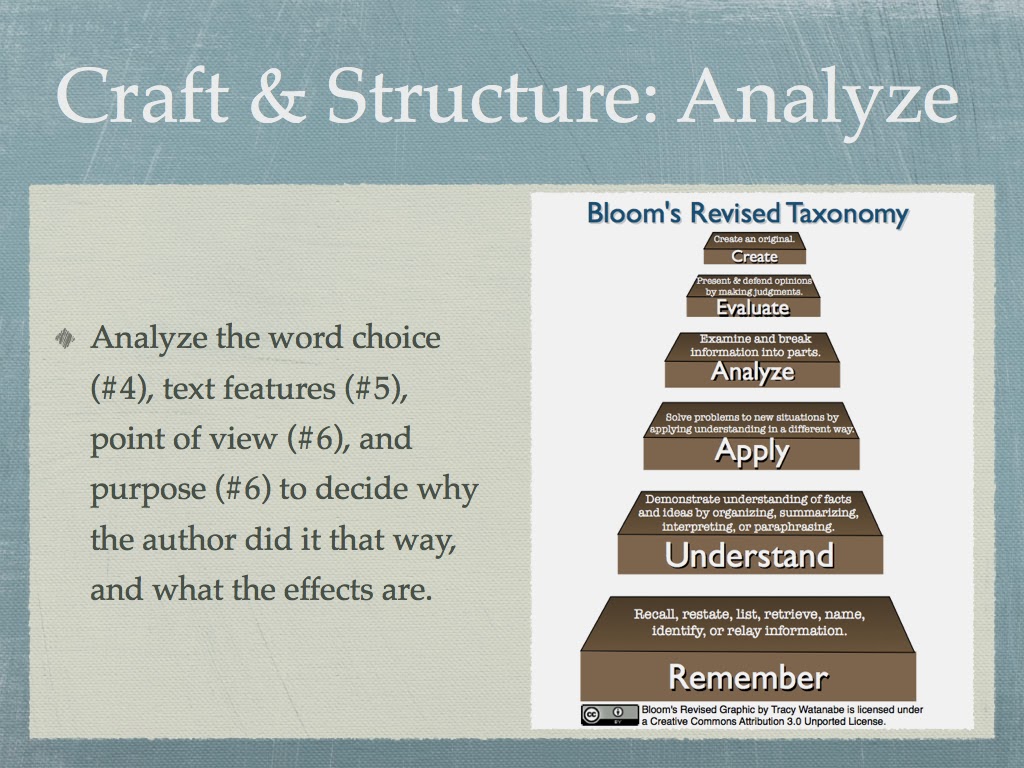
What type of thinking does the Common Core ask of students when it comes to Craft and Structure? Analysis. Analyzing the author's craft and structure is a shift for students to do, and a shift for teachers to design tasks and questions that require analysis.  This is the critical thinking we want students to engage in. Shifts The big shift in this is the analysis. What does that look like at the elementary level? How do you teach Craft and Structure? There are many ways to teach craft and structure . Make sure students are analyzing the text , not just identifying the answers . Craft structure close read questions from tracywatanabe Every spring, our school district uses Title IIa funds to pay teachers to attend training. This year, our Spring Academy focuses on various aspects of Common Core... and teaching Craft and Structure is one of the sessions. I was charged with creating a training module for the K-6 sessions. Training Document: ...

21st Century Learning, Literacy 2.0 and Common Core

One of the things that I love about AJUSD is how technology integration and 21st century learning is part of every layer of our district, from the students, to the teachers, to the site administrators, to the District Office, through a supportive School Board. Furthermore, one of the pieces that make us successful is the ongoing professional learning with the Superintendent, Principals, and the Education Services Team. Technology integration, PBL, and 21st Century Learning is not an afterthought, but rather it's planned into our conversations . Dr. Wilson makes sure we have discussions about how all the pieces and initiatives connect. Connecting PBL, the Common Core, and Teacher Evaluation Tool Below is a presentation from one of the Leadership Meetings earlier in the year. In a nutshell, here's what that training looked like: Think through a series of questions about what 21st century learning skills look like in the context of PBL, and as described in the Common Core ...

Analogies, Visual Representations and Metaphors for DOK

Image
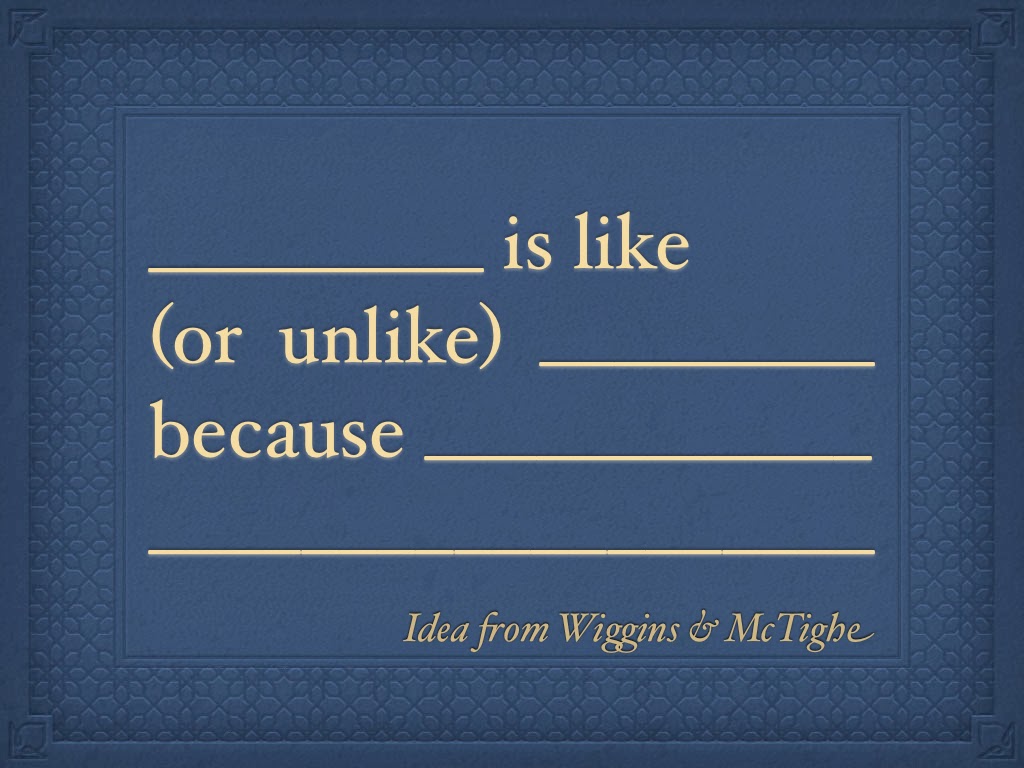
Our teams are focusing on creating rigorous learning activities by applying Webb's Depth of Knowledge (DOK) Level 3 and 4 tasks . "Webb developed four DOK levels that grow in cognitive complexity and provide educators a lens on creating more cognitively engaging and challenging tasks," ( New York City's Department of Education ). By focusing on DOK 3 and 4 levels, they are providing opportunities for students to engage in rigorous thinking as they connect with the content. This post will focus on analogies, visual representations, and metaphors as avenues for creating engaging DOK tasks. Analogies Analogy prompts are great ways to check for understanding (Wiggins & McTighe in UbD), and they are DOK 3 tasks. This can be done with any content area. Here are a few examples:  Finding the line of symmetry is like finding a matching shoe because both sides are now the same size and same shape. Spelling correctly is like washing your hands after usin...

Digital Storytelling and Stories with the iPad

Image
Digital storytelling is an art form conveying a message. It uses images and voice narration to convey emotion with the message, and to ignite empathy from the audience. It incorporates storyboarding and writing a script. It is created with digital tools and published on the Internet. I often think of digital storytelling as something done in first person because it creates that personal connection. Whereas, I think of a digital story as an anecdote or story typed or narrated in third person. Image attribution: Lyn Hilt's Slideshare , used with permission. Original work: "Writing- Pen & Paper" CC-by Laurie Richie Benefits Here are some of the many benefits of digital storytelling and digital stories: The 21st century skills and ISTE's Standards  applied are critical and creative thinking; written, oral, and digital communication; collaboration; authentic learning; digital fluency...