Posts

Vision, Urgency, and Measuring Effectiveness

Image
I've been involved in several discussions about leading change , which started with  vision and urgency. Everyone needed to be on the same page about the vision (the what), have a sense of urgency (the why), and know how we'd measure progress towards our goal. Having the vision relevant, tangible with benchmarks, and feedback reminded me of successful classroom practices. In the classroom, I made sure my students knew what we were learning, how it was relevant to them, how we'd measure progress towards our goal (the what, why, and how), and involved them in the process. I realized leading change had some of the same foundations, such as starting with the vision. Vision In order to be purposeful about change, the vision for what is wanted must be clear by everyone. If I asked, "What does it mean to be a 21st century, student-centered school district?" the answer must be clear in the minds of everyone. It must be clear to the administration , the teachers, ...

Working through Conflict

Image
Conflict can either break people and teams apart, or it can bring productivity and innovative solutions to move forward. The types of conflict that break people and teams apart are the interpersonal conflicts that occur. However, cognitive conflict is the disagreement about approaches and ideas. If the team recognizes and understands the types of conflict, it can be a resource to nurture productivity. Building teams and building trust The most constructive ways to deal with conflict is to use great communication skills, and connect with others to build trust and stronger relationships . By paraphrasing and asking questions, the issues stay separated from the person. Communication skills Shelee King George & me 2010 I once heard Shelee King George explain communication skills in an analogy of a phone call and call waiting: When we are listeners, we have three inhibitors that get in the way, so we need to put them on call waiting : 1) Autobiographical Lis...

iPads in Students' Hands

Image
This was our first year with iPads in the elementary classrooms, purchased with Title funding. Training with Tony Vincent We've had several trainings with Tony Vincent , starting with a three hour introduction and a two hour follow up with fabulous center ideas for literacy, fluency, and spelling. How I see them used in the classrooms  After Tony Vincent helped us get started, we've become more comfortable with using them, and we're at the point where we were figuring out new ways to use them. Here were some of the examples I've seen in the classrooms recently:   1. Previewing nonfiction text in Title I using ShowMe app Below was an example of how they were being used in Title I with Shelly Brossman . Shelly and I role played how to preview nonfiction text in this ShowMe video , created on the iPad in real time. Shelly then tried this with the students. They were completely engaged and paid more attention to their learning and why it was impo...

Lead, Coach, and Build Capacity

Image
Building capacity in the school district means improving and strengthening the learning in our students, employees, teachers, administrators, school board, and community. Coaching is a great way to build capacity, and leaders naturally build capacity. Finding leaders to assume leadership roles is an important part of the process. Please be aware that I don't believe a title makes someone a leader, it's just who they are. Leadership skills sets I've recently been involved in several conversations about building capacity. One of the conversations was about skills sets to look for when identifying leaders, specifically coaches.  I believe the following qualities are found in good coaches and leaders: People person : gels well with others and builds relationships Character: has integrity and is trustworthy Attitude: is positive even in negative circumstances Skills and productivity : able to get things done 21st century thinker : adapts, problem solves, is creativ...

Instructional Practices with Huge Impact

Image
So, you've done some formative assessment , and the results show you that the route you had planned to take with your instruction actually needs to adapt to where the students are at. Lesson planning and formative assessment remind me of planning a day trip. When I prepare for a trip, I like to have a plan or a route for where I'll go, where I'll park once I'm there, and what I'll do. Sometimes I need to make adjustments along the way, such as taking an alternative route when the street has construction work or is too congested. Other times, when I get there, the parking lot might be full, or I might find a more cost effective lot to park in. Lesson plans and formative assessment are similar because I start with a plan, but once I'm there, I realize that adjusting my plan to fit the circumstances and student needs are in our best interests. The formative assessments provide me with feedback on which route to take, what speed to progress at, and what pit st...

Formative Assessment and Differentiation

Image
Formative assessment informs educators about student learning, and when done correctly, it also informs the students how to improve and move forward with their next goal. Teachers must know how to use that information to shape their instruction. We use formative assessments to drive instructional decisions such as changing the approach or changing the target content. Created with Doodle Buddy , prompted by Stem Resources visual Differentiating assessment and instruction I spent February 10th with the awesome staff at Apache Junction High School facilitating staff development . While talking about differentiating assessment and instruction , we addressed the importance of adjusting our teaching style to their learning style . For example, I'm an exceptionally visual person, and like to synthesize and put concepts together in pictures such as the one above. In school, I enjoyed geometry and calculus, but struggled in Algebra II. In fact, I took calculus as my fun electi...

Managing the 21st century differentiated classroom

Image
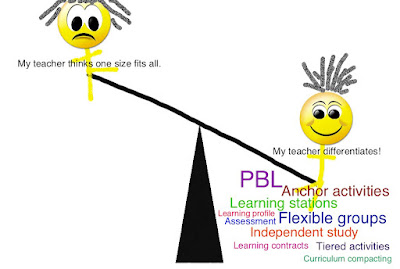
One size does not fit all. Classrooms must be differentiated. Created on iPad using Doodle Buddy What does a 21st century, differentiated classroom look like? A 21st century , differentiated classroom should look and sound different from the classroom of my childhood. It also looks different from one classroom to the next, because there are numerous ways to differentiate. AJHS Differentiated Instruction: Module I on Prezi What procedures and routines help maximize learning? The foundational pieces for managing the 21st century, differentiated classroom are: Increase active student engagement Establish a positive classroom climate Establish task expectations Increase student engagement through individual accountability The presentation was created in preparation for professional development for our high school, which will go to a 1:1 learning environment in 9th grade next year. What procedures, routines, and norms help stru...