Posts

iPads in Students' Hands
Image
This was our first year with iPads in the elementary classrooms, purchased with Title funding. Training with Tony Vincent We've had several trainings with Tony Vincent , starting with a three hour introduction and a two hour follow up with fabulous center ideas for literacy, fluency, and spelling. How I see them used in the classrooms  After Tony Vincent helped us get started, we've become more comfortable with using them, and we're at the point where we were figuring out new ways to use them. Here were some of the examples I've seen in the classrooms recently:   1. Previewing nonfiction text in Title I using ShowMe app Below was an example of how they were being used in Title I with Shelly Brossman . Shelly and I role played how to preview nonfiction text in this ShowMe video , created on the iPad in real time. Shelly then tried this with the students. They were completely engaged and paid more attention to their learning and why it was impo...

Lead, Coach, and Build Capacity

Image
Building capacity in the school district means improving and strengthening the learning in our students, employees, teachers, administrators, school board, and community. Coaching is a great way to build capacity, and leaders naturally build capacity. Finding leaders to assume leadership roles is an important part of the process. Please be aware that I don't believe a title makes someone a leader, it's just who they are. Leadership skills sets I've recently been involved in several conversations about building capacity. One of the conversations was about skills sets to look for when identifying leaders, specifically coaches.  I believe the following qualities are found in good coaches and leaders: People person : gels well with others and builds relationships Character: has integrity and is trustworthy Attitude: is positive even in negative circumstances Skills and productivity : able to get things done 21st century thinker : adapts, problem solves, is creativ...

Instructional Practices with Huge Impact

Image
So, you've done some formative assessment , and the results show you that the route you had planned to take with your instruction actually needs to adapt to where the students are at. Lesson planning and formative assessment remind me of planning a day trip. When I prepare for a trip, I like to have a plan or a route for where I'll go, where I'll park once I'm there, and what I'll do. Sometimes I need to make adjustments along the way, such as taking an alternative route when the street has construction work or is too congested. Other times, when I get there, the parking lot might be full, or I might find a more cost effective lot to park in. Lesson plans and formative assessment are similar because I start with a plan, but once I'm there, I realize that adjusting my plan to fit the circumstances and student needs are in our best interests. The formative assessments provide me with feedback on which route to take, what speed to progress at, and what pit st...

Formative Assessment and Differentiation

Image
Formative assessment informs educators about student learning, and when done correctly, it also informs the students how to improve and move forward with their next goal. Teachers must know how to use that information to shape their instruction. We use formative assessments to drive instructional decisions such as changing the approach or changing the target content. Created with Doodle Buddy , prompted by Stem Resources visual Differentiating assessment and instruction I spent February 10th with the awesome staff at Apache Junction High School facilitating staff development . While talking about differentiating assessment and instruction , we addressed the importance of adjusting our teaching style to their learning style . For example, I'm an exceptionally visual person, and like to synthesize and put concepts together in pictures such as the one above. In school, I enjoyed geometry and calculus, but struggled in Algebra II. In fact, I took calculus as my fun electi...

Managing the 21st century differentiated classroom

Image
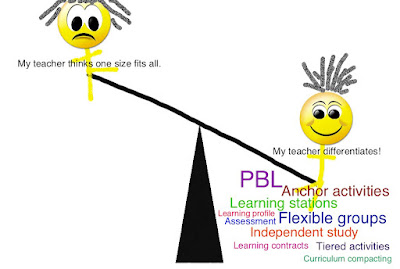
One size does not fit all. Classrooms must be differentiated. Created on iPad using Doodle Buddy What does a 21st century, differentiated classroom look like? A 21st century , differentiated classroom should look and sound different from the classroom of my childhood. It also looks different from one classroom to the next, because there are numerous ways to differentiate. AJHS Differentiated Instruction: Module I on Prezi What procedures and routines help maximize learning? The foundational pieces for managing the 21st century, differentiated classroom are: Increase active student engagement Establish a positive classroom climate Establish task expectations Increase student engagement through individual accountability The presentation was created in preparation for professional development for our high school, which will go to a 1:1 learning environment in 9th grade next year. What procedures, routines, and norms help stru...

Blended Learning in AJUSD

Image
Our district focuses on creating 21st century , student-centered classrooms. We want classrooms filled with student collaboration and discussion about their learning, connecting to the world around them. Some rights reserved by tgbarrett Blended learning Students learn in different ways, and at different paces. To address these needs, we've been piloting blended learning in two high school classrooms. AJUSD's definition of blended learning is: Blended learning combines the best features of in-class learning with the best features of online learning. Online delivery allows student control over the time, place, path, and/or pace of their learning. In-class learning provides student-teacher interaction as well as opportunities for students to collaborate on challenging, project-based work.  By having content online, students have more time on task. They can pause the content, go back to revisit lectures/lessons, and have control over the pacing of their ...

Coaching and Professional Development Midyear Reflection

Image
This post is my reflection (and brainstorm) for creating a 21st century learning district, specifically through developing our Collaboration Coaches . I’m asking for your feedback. The focus for Year 2 Collaboration Coaches This is the second year we’ve had Collaboration Coach training in the district. The first year training module is closely adapted from Microsoft Peer Coach Training developed by the Peer Ed Team. Since there isn’t a continuation training module, I’ve created my own based on surveys, reflections, and four areas of focus: Communication, collaboration, and coaching skills  21st century learning, pedagogy, and lesson design Best practices with technology integration and resources Staff development The professional development plan for Year 2 Collaboration Coaches August : Setting goals and overview of year -- for the purpose of kicking off the year September : Web 2.0/Coaching Smackdown   -- focusing on best practices; resources; and ideas for...